
In the first few days of April, the Resolution was well into icy waters, and safe from attack from privateers. As in later years, passing beyond about 68 deg latitude seems to bring a reflective air to Scoresby’s otherwise matter of fact journals. On Monday 1st April he records “Light airs fine frosty weather” and notes “The Aurora Borealis was uncommonly brilliant in the twilight it assumed a smoky tinge”. Later in the day, the amount of ice increased, and on the 2nd, the ship became “entangled”.
Having worked their way clear, there was time for the harpooners to begin preparations for their arrival in the whaling grounds. They “cut foregangers, spliced in harpoons and placed two boats at the Quarters of the Ship”. Foregangers were lengths of flexible rope, of about nine yards in length, which were attached at one end to the harpoon, and at the other to the heavy, rigid whale lines. Foregangers made throwing the harpoon easier, and harpooners paid special attention to them, weaving into the splicing ribbons given them by sweethearts and wives.
On April 3rd, in amongst heavy ice, the amount of sail was reduced. The wind increased to a severe gale, and Scoresby discovered that “Through carelessness or mistake of orders” the ship had drifted too far to leeward, and was in amongst large pieces of ice in heavy seas, and snow. The following day, after laying to over night, the Resolution “made all sail” to the East North East. Thursday April 4th was “charmingly fine”. On this day Scoresby records that they had passed 70 deg latitude.
The Resolution made good progress from Shetland; in the last week of March Scoresby navigated from 62 deg 51 North to 68 deg 30 North, and entered the brash ice. The whaling fleet passed the northernmost point of Zetland at 5pm on the 25th and “met a very heavy sea” which did not suit the Resolution. With the Sarah and Elizabeth astern, the morning of the 26th brought fresh gales and fine weather, and they made good progess. Scoresby alloted the men to boats and appointed the harpooneers. In the evening, eight ships were in sight.
The temperature began to fall noticeably on the 27th, and on the 28th there was snow. It was still early in the season, and the ice was as yet quite far south. It snowed heavily on the 29th, and the “Aurora Borealis was uncommonly brilliant”. On the 30th, Scoresby noted that the snow was not melting in the sea. He suspected ice was near, and took a temperature reading of the seawater, finding it was 33 F–just above freezing. Soon the Resolution was amongst ice, though in broken up streams. By then the threat from French naval vessels was receding, so Scoresby ordered the guns dismantled: “All hands were turned up at 9 AM to unload dismount the carriage Guns and stow them away.”
On the 31st, the Sarah and Elizabeth of Hull hove into view again. By then they had reached 68 deg 30 N, and the ice was thicker:
At mid’nt we tacked and stood in towards the Ice which we made about (6.30) am consisting of disseminated heavy pieces and brash streams[.] Stood in NbW tacking occasionally until we came to Ice so close as to be impassable. A few miles west appeared to be impervious[.] The Ice was washed and moderately heavy.
Scoresby was already developing an interest in the problems of calculating longitude, notably the reliability of clocks and watches near the magnetic pole. He made “seven sets of observations on the time, distance and altitudes from [the sun and moon] and the time regulated again in the afternoon the Longitude of the ship proved to be 5 deg 2 W. Watch per Greenwich 1 [minute] 35 too slow.”

Brassa Sound separates the island of Brassa (now known as Bressay) from the mainland of Shetland, where Greenland whale ships often called to pick up crewmembers, water, and other supplies on their way north. On Saturday March 16, 1811, at around 2pm, Scoresby brought the Resolution to anchor ‘about the midddle ground,’ not far from Shetland’s main settlement, Lerwick. Also in the sound were four other Whitby ships, as well as the Egginton and Harmony of Hull, and the Fountain of Lynn. The following day, Sunday, the crew attended church on shore, and over the course of the following week, the ship was inspected, and seawater taken on board as ballast. Scoresby had problems with insufficient draft in Whitby harbour, so the ship was not carrying enough when it sailed on March 11th.
The weather during the stay in Shetland was unpleasant, and at one point the the ship lurched so hard the anchors seemed to be dragging. Scoresby used some of the time writing letters, in particular to ‘Miss L’, his future wife, Mary Eliza Lockwood. The Sloop of War Cherokee came in, giving reassurance to the whale fleet, which was then under threat from the French. The Resolution sailed for the whaling grounds on Sunday March 24th:
The wind being favourable at about 6AM “knocked out” all hands and as quickly as possible weighed the anchor hanging the Ship in the mean time by the Henrietta with a warp sailed safely out of the Harbour and hove too at the mouth gave the Pilots some Beef Pease and Oatmeal a little Brandy also their fee for Pilotage and attendance then dismissed them made sail. At noon moss head bore about SWbW distance 15 miles.
Map from the National Library of Scotland military maps collection.
In March 1911, Roald Amundsen and his expedition were settling in to their winter quarters at Framheim on the Ross Ice Barrier. They had set off from Norway in June 1910, and planned to make their attempt to reach the Pole in the Antarctic Spring, in October, 1911. While the heroism of the ‘Southern Party’ has been much celebrated, little has been written about other aspects of the expedition, which Amundsen insisted was a scientific one. Among other things, it was hoped that a party would be able to map the ‘Bay of Whales’. This task was undertaken by Lieutenant K Prestrud, and is recounted in his chapter in Amundsen’s book The South Pole (1912), entitled ‘The Eastern Sled Journey’. Antarctica changed many of Prestrud’s views, from his culinary tastes (he decided quantity was better than variety), to his tolerance of cold (late in 1911, -20 C felt like a pleasant Spring day), but in some things he could not escape his time. Despite having ‘no special knowledge of the industry’. Prestrud viewed the Bay of Whales as a lucrative, but sadly inaccessible resource:
The name of the Bay of Whales is due to Shackleton, and is appropriate enough; for from the time of the break-up of the sea-ice this huge inlet in the Barrier forms a favourite playground for whales, of which we often saw schools of as many as fifty disporting themselves for hours together. We had no means of disturbing their peaceful sport, although the sight of all these monsters, each worth a small fortune, was well calculated to make our fingers itch. It was the whaling demon that possessed us.
…
Lastly, it must be said that, although in the bay itself huge schools of whales were of frequent occurrence, we did not receive the impression that there was any great number of them out in the Ross sea. The species most commonly seen was the Finner; after that the Blue Whale.
In 1811 William Scoresby Jr. sailed to the Greenland sea in command of his own ship for the first time. He was 21 years old and had by then spent nine summers in the Arctic, first as apprentice to his father, and later as chief mate on the Resolution, his father’s ship. In 1806, the Scoresbys achieved the record for ‘furthest north,’ reaching a latitude of 81 degrees 30′ north, a record that stood unbroken until 1827.
By 1811, when Scoresby Jr. took over command of the Resolution from his father, he was an accomplished whaler and expert navigator. He had studied, at the University of Edinburgh, and had served in the rescue of the Danish fleet from occupied Copenhagen. He was emerging as a scientist of some talent, and a keen observer of the world around him. In his introduction to the first volume of Scoresby’s journals, C. Ian Jackson notes that even as early as 1807, Scoresby had met Sir Joseph Banks, impressing him enough for the teenager to be invited to social occasions with the most eminent natural scientists in Edinburgh at the time, in particular Robert Jameson, Professor of Natural History at the university there.
Scoresby begins the first of his extraordinary journals, part scientific journals, part customs inspectors’ logs, on March 11th, 1811, with the Resolution about to leave Whitby for the whale fishery. Guns were loaded because, in 1811, Britain was at war, and whaling ships were valuable targets:
The ship not having floated on the morning tide some things were moved forward to trim her being near one foot by the [Stern?] as regards the draught of water[.]
The weather fine and favourable made preparation for the sailing[.] At 3PM several of the other Greenland Ships were in motion it was not until near full tide however that we were enabled to heave the Resolution off the Ground we presently afterwards hauled through the Bridge nearly as far as the pier where we made sail and got safe out of the harbour[.] At 5 1/2 PM the Pilot left us we then made sail loaded a few of the guns[.] In the Morning fine weather moderate or fresh breezes and hazy[.] … steering to the NNE the rate of 6 to 8 knots[.]
Over on the Venetian Vase I have a short note about Arthur Conan Doyle’s visit to the Arctic in 1880, on board the whaler Hope of Peterhead:
In the Spring of 1880 Arthur Conan Doyle, then a 21 year-old medical student, sailed as ship’s surgeon on board the Hope, an Arctic whaler, out of Peterhead. The Hope was a modern vessel with an auxiliary steam engine to go with its three masts, and in his brief reminiscence about the voyage, “Whaling in the Arctic Ocean” Conan Doyle says: ”What surprised me most about the Arctic regions was the rapidity with which you reach them. I had never realised that they lie at our very door. I think that we were only four days out of Shetland when we were among the drift ice.”
Today’s news that the Japanese whaling fleet has suspended operations in the Antarctic is very good indeed. While the protest group Sea Shepherd has been criticised (largely by the whalers) for ‘dangerous’ tactics, whaling is as indefensible in 2011 as public floggings, or slavery. For a small number of Japanese, whaling is a matter of national pride: whale meat was an important source of food in the years following World War 2, and whaling was one of the purposes to which military ships were adapted in a period when Japan was forced into what some saw as a humiliating disarmament. Of course, what we now call scientific whaling, isn’t really.
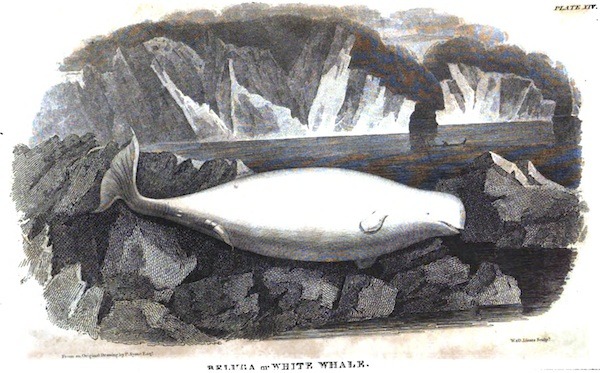
Scientific whaling goes back a long way, but 200 years ago it didn’t mean quite the same thing as it does now. In 1820, when William Scoresby published his Account of the Arctic Regions, whale products were central to life in the industrialised world, so much so that British whalers were subsidised, and heavily regulated by the government, to prevent whalers selling their catches elsewhere. Most whalers saw their sole purpose as being to catch whales, but Scoresby spent large amounts of time documenting them, and describing their behaviour. Even though some of what he recorded has turned out to be mistaken, including his conclusion that whales have poor hearing, but excellent eyesight, Scoresby’s observations were significant scientifically, as well as for the commericial success of the whale fishery.
Scoresby’s skill and success as a whaler allowed him to make discoveries that might otherwise have taken many decades to come to light. Certainly his Account of the Arctic Regions remained the primary work in the literature of the Arctic for almost a century, and, for all its faults, a landmark in the natural history of the whale. Whaling also allowed Scoresby to make voyages of exploration. He charted the east coast of Greenland, measured the varying density of seawater, and conducted experiments with magnetism that were only possible in close proximity to the North Pole.
But Scoresby also knew that the commercial and practical necessities of whaling held back scientific discovery and exploration. In fact, while Scoresby himself was careful to record measurements of harpooned whales, many of the descriptions he cites of whale physiology come from stranded animals, not captured ones. Similarly, despite being well equipped to do so, whalers could not afford to take up the challenge of searching for the North West Passage, even for a £20,000 prize. In 1817, Scoresby concluded in a letter to Joseph Banks that the demands of whaling, and the expense of hiring a ship and crew for a speculative voyage, made such attempts impossible: ‘Now it is evident to those who visit the Greenland seas that were such a passage accomplished, it might not be again practicable in ten or even twenty years–it is evident that no premium could be adequate to the expense.’ (quoted in T&C Stamp, William Scoresby, Arctic Scientist, 1976, p. 67). Scoresby himself petitioned the Admiralty in 1817 for the command of a dedicated expedition, but was turned down in favour of less experienced naval officers.
The question of food on board an Arctic whaler is a matter of some mystery. While there are accounts of the proceedings on board ship in the act of pursuing and catching whales, little is known about the lives of the whalers themselves. William Scoresby Jr. documents the provisions loaded onto a whale ship in preparation for the fishery: vast quantities of salt pork, hams, and beef, as well as bread, and potatoes, but little else. Variety might be had in the form of whale meat, fish, or seabirds. Scoresby notes that the price of Shetland oysters doubled when ships were nearby.
Basil Lubbock, whose The Arctic Whalers (1937) remains an important work in the history of the ‘fishery’ devotes little more than a paragraph or two to the subject of food, and then only to say that the ‘half deck’ men received better quality rations than the rest of the crew. These men were skilled hands, and included the second mate, harpooners, cooper, carpenters, and the specksioneer. They shared a mess, where they received their own special menu, which included a ration of cheese, and ‘Sea Pie’. Lubbock gives the following description, taken from a sailor’s log, written in 1820:
This savoury dish was made in layers or decks; the first one of bones to keep the paste from burning to the bottom of the pan; then followed a stratum of fresh beef paste and seasonings, deck after deck, until the great kettle was full. Sufficient water was added to enable the mess to be cooked. (Lubbock, p.53)
Captains fared rather better. The closest recipe I can find to this is in Hannah Glasse’s The Art of Cookery Made Plain and Easy (1747), in the chapter headed For Captains of Ships:
To make a Cheshire Pork Pie for Sea
Take some salt pork that has been boiled, cut it into thin slices, an equal quantity of potatoes, pared and sliced thin, make a good crust, cover the dish lay a layer of meat seasoned with a little pepper and a layer of potatoes, then a layer of meat, a layer of potatoes, and so on, till your pie is full. Season it with pepper, when it is full, lay some butter on the top, and fill your dish above half full of soft water. Close your pie up and bake it in a gentle oven.
Elsewhere in the same chapter is a recipe for a ‘Catchup to keep twenty years’:
Take a gallon of strong stale beer, one pound of anchovies washed from the pickle, a pound of shalots peeled, half an ounce of mace, half an ounce of cloves, a quarter of an ounce of whole pepper, three or four large races of ginger, two quarts of the large mushroom flaps rubbed to pieces. Cover all this close and let it simmer till it is half wasted then strain it through a flannel bag, let it stand till it is quite cold, then bottle it. You may carry it to the Indies. A spoonful of this to a pound of fresh butter melted makes a fine fish sauce or in the room of gravy sauce. The stronger and staler the beer is, the better the catchup will be.

Few people in history can have been more experienced in dealing with cold than Arctic whalers. This 1820 account by William Scoresby, master of the Baffin gives an insight into the conditions on board ship, and is smart advice on how to stay warm for longer in very cold conditions. Bear in mind that the temperatures he describes are in Fahrenheit, so 10 degrees, is actually -12 Celcius, and of course 60F is around 15C. At -12C, Scoresby found he could remain at the masthead “for several hours without uneasiness” if he drank tea beforehand:
It is a prevailing opinion, that sudden transitions from heat to cold, are very inimical to health. Where the heat is productive of copious perspiration, the sudden exposure to cold might operate unfavourably; but where no sensible perspiration prevails, I have never seen, in a healthy person, any ill effects resulting from the greatest transitions. For my own part, indeed, whenever I have occasion to expose myself to a severe cold, I like to get the body well warmed, finding that the more I am heated the longer I can resist the cold without inconvenience. Internal warmth, however, is clearly preferable to superficial heat, and the warmth produced by simple fluids, such as tea or soup, preferable to that occasioned by spirits. After the liberal use of tea, I have often sustained a cold of 10°, at the masthead, for several hours without uneasiness. And though I have often gone from the breakfast table, where the temperature was 50 or 60 degrees, to the mast-head, where it was 10°, and without any additional clothing excepting a cap, yet I never received any injury, and seldom much inconvenience from the uncommon transition. Hence when the sea is smooth, so that the smoke of the stove can make its escape, I generally have my cabin heated as high as 50 or 60 degrees, and sometimes upward, though I am liable to be called upon deck or even to the mast-head, at a moment’s warning.
 Letters to Elizabeth